Published Books
Three books on smart grid technology, cyber-physical security and fault diagnosis, published with Elsevier and available on Amazon.
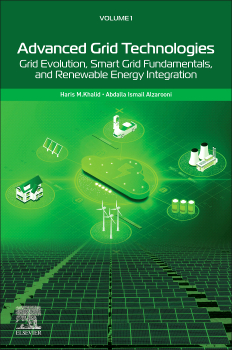
Advanced Grid Technologies, Volume 1
Grid Evolution, Smart Grid Fundamentals, and Renewable Energy Integration · Elsevier · ISBN 978-0-443-29851-6
A practical introduction to the modern techniques needed to integrate renewable energy into power grids. The book opens with the history of the modern energy grid, then gives a comprehensive overview of renewable energy sources, the challenges they create for conventional grids, and the fundamentals of smart grid adaptation.
Each major challenge is broken down from first principles, covering electric vehicles and vehicle-to-grid systems, energy storage, intelligent electronic device-based substations, and demand forecasting for energy stability. With numerical examples throughout, it serves senior undergraduates, graduate students in energy systems and power engineering, and engineers working to modernise the grid.
Cyber-physical Infrastructures in Power Systems
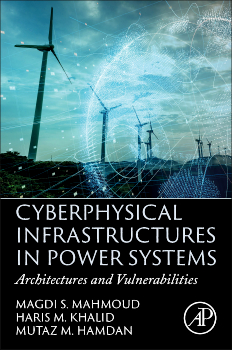
Architectures and Vulnerabilities · Elsevier · ISBN 978-0-323-85261-6
Keeping large-scale power systems secure and stable is one of the hardest problems power engineers face today. Traditional operations and control decisions rest on physical models built from simplifying assumptions, but the complexity of stability problems, combined with inherent uncertainty and nonlinearity, often makes those models impractical or inaccurate. This calls for adaptive and deep-learning algorithms to improve the control schemes behind decision and control problems.
The book gives an extensive overview of cyber-physical system concepts and infrastructures in power systems, with a focus on current research. It covers:
- Theoretical preliminaries and the fundamental issues behind CPS architectures.
- Control and communication methodologies applied to units within smart power systems and microgrids.
- Advanced analysis under cyber-physical attacks, with resilient control strategies for safe operation across power levels.
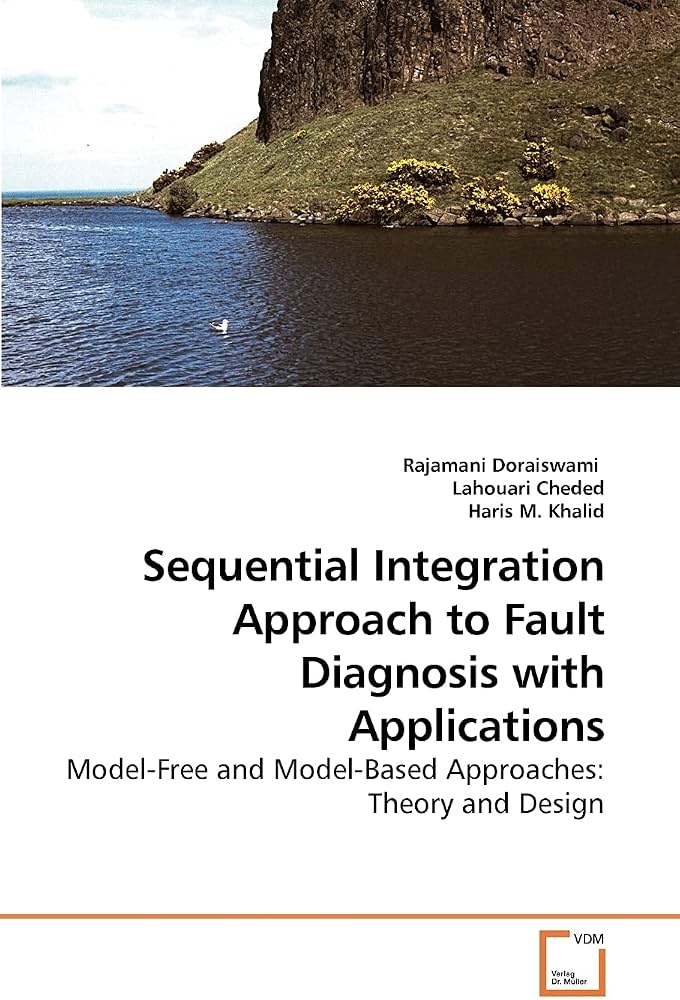
Sequential Integration Approach to Fault Diagnosis with Applications
Model-Free and Model-Based Approaches: Theory and Design · Available on Amazon
As engineering systems grow more complex, sustaining reliable high performance becomes harder, and fault diagnosis is the tool that addresses it. This book introduces the sequential integration of the two major diagnostic approaches, model-free and model-based, drawing on the strengths of both to detect incipient faults that neither approach uncovers alone.
On the model-free side, it moves from intuitive plausibility checks through to learning methods such as artificial neural networks, fuzzy logic and genetic algorithms, including hybrid versions. On the model-based side, it builds on the Kalman filter and contributes two pieces of new material: a model-order selection criterion designed for practising engineers, and a fresh approach to Kalman filter design grounded in the internal model principle.